 |
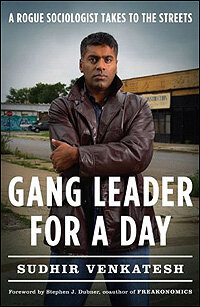
| Gang Leader For a Day |
J.T. just sat for a moment, making no move to drive off. "Okay, well, you want to give it a try? If you think it's so easy, you try it."
"I don't think that would be possible. I don't think graduate school is really training me to lead a gang."
"Yeah, but you don't think I need any skills at all to do this. So you should have no problem doing it, right?"
It was true that sometimes his job looked hard. When his gang was warring with another gang, for instance, J.T. had to coordinate his troops and motivate 15-year-old kids to stand out in the open and sell drugs despite the heightened risk of being shot, beat up, or arrested. And it wasn't as though these kids were getting rich for their trouble. The B.K.'s, like most other street gangs, had a small leadership class. J.T. kept only a few officers on his payroll: a treasurer, a couple of "enforcers," a security coordinator, and then a set of lesser-paid "directors" who managed the six-person teams that did the actual street-level selling of crack.
Sudhir joked to J.T., the leader of the Black Kings, that he is seriously overpaid because of how easy his leadership position in the gang seemed to be; however, he soon found out this wasn't the case. It seems hard enough to have to ignore all morals to even be involved in the drug business, but it seems J.T. doesn't mind. He even trains fifteen year old boys to mule drugs around and make them a thin profit compared to his. Besides that, J.T. seems to be quite organized like a legitimate corporation by hiring different people that seemed to have enough knowledge to take on roles like gang treasurer. There is clearly an established hierarchy here and J.T. is the CEO of it all.
J.T. seemed to appreciate having the ear of an outsider who would listen for hours to his tales of bravado and managerial prowess. He often expressed how hard it was to manage the gang, to keep the drug economy running smoothly, and to deal with the law-abiding tenants who saw him as an adversary. Sometimes he spoke of his job with the same dispassion as if he were the C.E.O. of some widget manufacturer — an attitude that I found not only jarring but, given the violence and destruction his enterprise caused, irresponsible.
He fancied himself a philanthropist as much as a leader. He spoke proudly of quitting his mainstream sales job in downtown Chicago to return to the projects and use his drug profits "to help others." How did he help? He mandated that all his gang members get a high-school diploma and stay off drugs. He gave money to some local youth centers for sports equipment and computers. He willingly loaned out his gang members to Robert Taylor tenant leaders, who deployed them on such tasks as escorting the elderly on errands or beating up a domestic abuser. J.T. could even put a positive spin on the fact that he made money by selling drugs. A drug economy, he told me, was "useful for the community," since it redistributed the drug addicts' money back into the community via the gang's philanthropy.
J.T. seems to be filled with contradiction. He relies on the immoral activity of drug dealing for him to reap in profits, and even hires fifteen year old employees to do quite risky business. However, he keeps his employees in check by making sure they graduate high-school and stay off the drugs that they are dealing. He will throw his employees on the street to make a dangerous transaction but also to help an elderly woman cross the street safely. J.T. is maximizing the efficiency of his labor for top profit. He even claims that reaping money from drug addicts eventually helps the economy. When the money is taken from the addicts, his employees spend that money on legitimate business, thus stimulating the economy.
Future research: Read more from this book and also Freakonomics in order to learn: What are the similarities between legitimate and illegitimate business?

No comments:
Post a Comment